

Titanium Extraction
Titanium is one of the more abundant elements in the Earth’s crust, but it is virtually never found in nature in metallic form. Instead, it occurs chemically bound in various minerals.
Economically significant titanium raw materials are extracted in different regions of the world. For industrial titanium production, minerals with a high titanium dioxide content are particularly important.
Titanium-bearing minerals include rutile, ilmenite, anatase and brookite. Rutile and ilmenite are particularly important for industrial titanium production.
Further information about the properties of the resulting material can be found under Material Properties of Titanium.
Rutile and Ilmenite as Important Titanium Raw Materials
- Rutile consists predominantly of titanium dioxide (TiO₂) and has a high titanium content. This makes it particularly suitable as a raw material for further processing.
- Ilmenite is an iron-titanium oxide and is also one of the world’s most important titanium raw materials. Due to its iron content, additional processing steps are required before the titanium it contains can be further processed.
In addition to rutile and ilmenite, titanium occurs in numerous other minerals. For industrial metal production, however, it is not only the occurrence of these minerals that matters, but particularly their titanium content, availability and economic viability of processing.
How is Metallic Titanium Extracted from Titanium Ore?
Industrial titanium production takes place in several process stages. One established method for producing metallic titanium is the Kroll process.
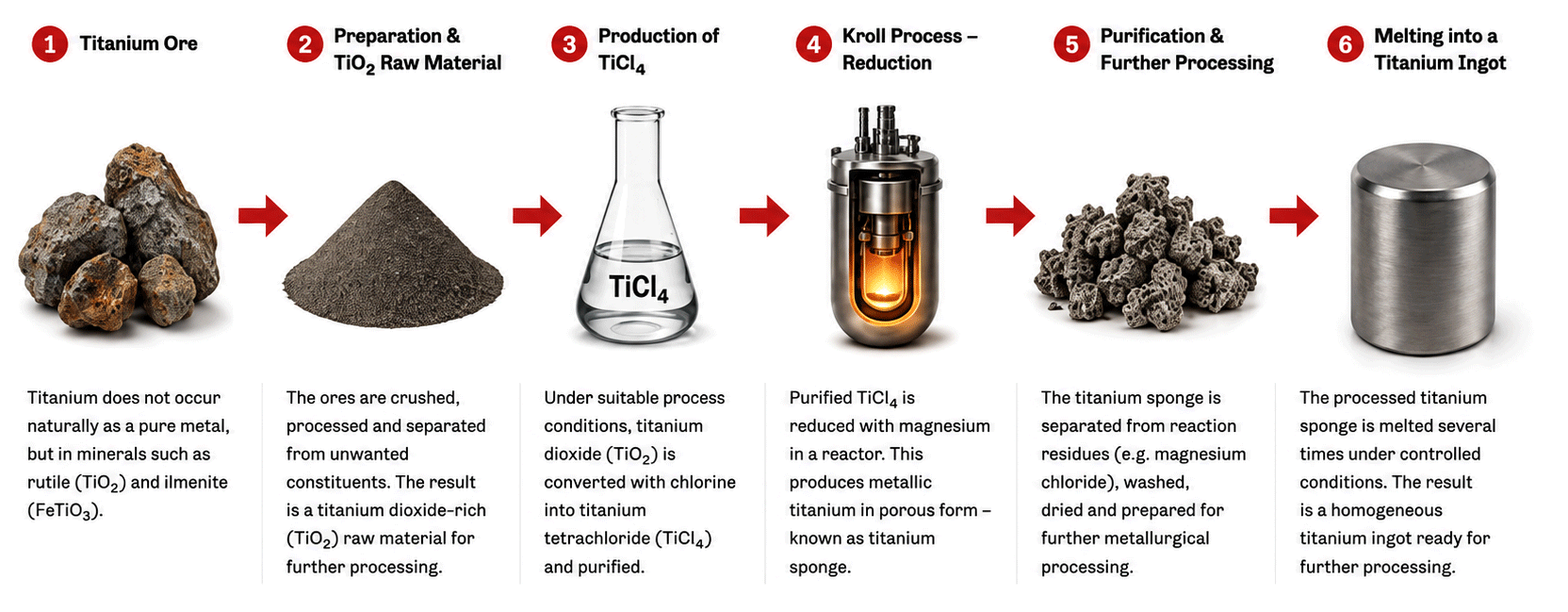
In simplified terms, titanium extraction can be divided into the following steps:
- Preparation of the Raw Material
Titanium-bearing raw materials such as rutile or processed ilmenite are prepared for further processing. - Production of Titanium Tetrachloride
The titanium dioxide is converted into titanium tetrachloride (TiCl₄) under suitable process conditions and subsequently purified. - Reduction to Metallic Titanium
In the Kroll process, purified titanium tetrachloride is reduced with magnesium. This produces metallic titanium in a porous form known as titanium sponge. - Purification and Further Processing
The titanium sponge is freed from reaction residues, processed and prepared for further metallurgical processing. - Melting into a Titanium Ingot
The processed titanium sponge is melted under controlled conditions. Depending on the required quality, several melting operations may be necessary before a homogeneous titanium ingot is available for further processing.
From Titanium Ore to a High-Performance Material
Titanium extraction is a multi-stage, technically demanding process – and one of the key reasons for the high value of the material.
A Complex Process for Exceptional Properties
The complex extraction and processing of titanium make it comparatively expensive. In return, the material offers a unique combination of low weight, high strength and excellent corrosion resistance – providing genuine technological and economic benefits in demanding applications.
From Titanium Sponge to an Engineering Material
The titanium sponge produced during metal extraction is not yet a finished semi-finished product or component. Its name derives from its characteristic porous structure.
For further use, the titanium sponge is processed and melted. Depending on the desired material, specific alloying elements can be added during this stage. This produces different titanium materials with specific mechanical, thermal and chemical properties.
The various commercially pure titanium grades and titanium alloys, together with their technical differences, are explained in more detail under Titanium Grades.
Why is Titanium Extraction so complex?
Titanium extraction differs significantly from the production of many other metallic materials. At elevated temperatures in particular, titanium reacts strongly with oxygen, nitrogen and carbon. Unwanted contamination can significantly affect the properties of the resulting material.
Controlled process conditions and sophisticated metallurgical procedures are therefore required. In addition, several processing stages are necessary – from the mineral raw material through chemical intermediates and titanium sponge to the melted titanium material.
This combination of process complexity, energy requirements and high demands on material quality is a major factor in the cost of titanium. A more detailed economic assessment can be found under Why is Titanium so Expensive?
From Titanium Production to the Finished Component
Once extraction and metallurgical production are complete, the actual processing of the material begins. Depending on the titanium grade, component geometry and application, different manufacturing and machining processes can be used.
Form & Technik has many years of experience with titanium and various processes for manufacturing demanding titanium components. These include Titanium Investment Casting, 3D-Printing, Titanium Graphite Casting, Titanium Forgings, Titanium Tubes and custom-made Titanium Parts.
Special requirements also apply to machining and joining the material. Further information can be found under Machining & Welding of Titanium.
The Application, not just the material price, Is what matters
Titanium is not the technically or economically most suitable material for every application. Where a conventional material reliably meets all requirements, it may provide the more economical solution.
The situation changes when low weight, high specific strength, corrosion resistance or long service life become decisive factors. In these cases, the price per kilogram should not be considered in isolation. Instead, the overall technical and economic performance of the component throughout its intended service life should be evaluated.
Form & Technik has many years of experience with titanium, its material properties and different manufacturing processes. We are happy to support you in evaluating which titanium solution is suitable for your specific application.
Frequently Asked Questions About Titanium Extraction and Production
Which raw materials are used to produce titanium?
Titanium-bearing minerals such as rutile and ilmenite are particularly important for industrial titanium production. Rutile has a high titanium dioxide (TiO₂) content, while ilmenite is an iron-titanium oxide and requires additional processing steps. The choice of raw material depends on factors such as titanium content, availability and processing requirements.
What is titanium sponge and why is it called that?
Titanium sponge is a porous form of metallic titanium produced during the reduction of titanium tetrachloride in the Kroll process. Its sponge-like structure gives the material its name. Titanium sponge is not yet a finished material or semi-finished product. It is purified, processed and subsequently melted for further metallurgical processing.
Why can't titanium simply be smelted from its ore like iron?
Titanium has a strong affinity for elements such as oxygen, nitrogen and carbon and is particularly reactive at elevated temperatures. It therefore cannot be extracted using conventional metallurgical processes comparable to those used for iron and steel. Producing metallic titanium requires specialized chemical and metallurgical processing steps.
What role does magnesium play in the Kroll process?
Magnesium acts as the reducing agent in the Kroll process. Purified titanium tetrachloride (TiCl₄) reacts with magnesium to form metallic titanium. Magnesium chloride is produced as a by-product. After the reaction, residual materials are removed and the resulting titanium is prepared for further processing.
How is titanium sponge turned into a specific titanium alloy?
To produce a titanium alloy, processed titanium sponge is melted together with the alloying elements required for the desired material. Composition and melting conditions are carefully controlled to achieve the specified material properties. This process produces different commercially pure titanium grades and titanium alloys for a wide range of technical applications.
Are you planning an Application using Titanium?
Selecting the appropriate titanium material and manufacturing process depends on numerous factors, including component geometry, mechanical requirements, operating conditions and production quantity.
Form & Technik supports you in the technical evaluation and selection of a suitable solution for your project. Talk to us about your requirements – from material selection to the finished titanium component.