

Titanium Standard Comparisons and Technical Data
Titanium and titanium alloys are classified internationally according to different material standards and designation systems. Depending on the application and country of origin, designations based on ASTM, AMS, DIN, EN or ISO may be used.
For design, material selection and procurement, it is therefore important to correctly interpret the different designations. Comparison tables can help to match titanium grades, material numbers and international specifications and identify suitable materials for a technical application.
In addition to the standard designation, the technical properties of the respective titanium material also play a decisive role. Density, strength, modulus of elasticity, temperature behaviour and other key values determine whether a material is suitable for the intended loads and operating conditions.
This page provides an overview of important titanium standards, titanium grades and technical data, as well as comparisons with other metallic materials.
Titanium Materials and International Standards Compared
Titanium materials are designated according to different standards and specifications depending on the country, industry and field of application. A material may therefore be identified by a German or European material number, an ASTM grade or another international specification.
The following overview compares important designations for commonly used titanium materials. It provides guidance for material selection, technical specification and international procurement.
It is important to note that comparable material designations do not automatically indicate complete technical equivalence. For a specific application, the applicable standard, delivery condition and the chemical and mechanical properties defined within that standard must always be considered.
| Titanium Grade | Material No. | Material / Designation | UNS | ASTM Grade |
|---|---|---|---|---|
| Grade 1 | 3.7025 | Commercially Pure Titanium / Ti 1 | R50250 | Grade 1 |
| Grade 2 | 3.7035 | Commercially Pure Titanium / Ti 2 | R50400 | Grade 2 |
| Grade 3 | 3.7055 | Commercially Pure Titanium / Ti 3 | R50550 | Grade 3 |
| Grade 4 | 3.7065 | Commercially Pure Titanium / Ti 4 | R50700 | Grade 4 |
| Grade 5 | 3.7164 / 3.7165 | Ti-6Al-4V | R56400 | Grade 5 |
| Grade 7 | 3.7235 | Ti-Pd | R52400 | Grade 7 |
| Grade 9 | 3.7195 | Ti-3Al-2.5V | R56320 | Grade 9 |
Note: Standards and specifications may vary depending on product form and delivery condition. For specific material selection, the requirements of the applicable product specification must always be considered.
Titanium Materials for Aerospace Applications
Titanium materials play an important role in aerospace applications due to their high specific strength, corrosion resistance and good properties at elevated temperatures. They are used for structural parts as well as technically demanding components.
In addition to the titanium grade itself, the respective product specification is particularly important in this field. AMS (Aerospace Material Specifications) define requirements for materials and take factors such as product form and delivery condition into account.
A titanium material may therefore be assigned to different AMS specifications depending on whether it is supplied as sheet, plate, bar, forging or tube, for example.
The following overview shows some typical examples:
| Titanium Material | Typical Product Form | Example Aerospace Specification |
|---|---|---|
| Grades 1–4 Commercially Pure Titanium |
Bar / Forging | AMS 4921 |
| Grade 5 Ti-6Al-4V |
Sheet / Strip / Plate | AMS 4911 |
| Grade 5 Ti-6Al-4V |
Bar / Forging | AMS 4928 |
| Grade 9 Ti-3Al-2.5V |
Tube | AMS 4943 |
Note: The AMS specifications listed above are provided for general guidance. The specification required for a particular component depends on factors including the material, product form, delivery condition and the requirements of the respective aerospace application.
Technical Properties of Titanium
The technical properties of titanium are not determined by the base material alone. Titanium grade, alloy composition, microstructure, heat treatment and product form can significantly influence its mechanical and physical properties.
One of titanium’s characteristic features is its combination of comparatively low density and high strength. Commercially pure titanium has a density of around 4.5 g/cm³, while Ti-6Al-4V (Grade 5) has a density of approximately 4.43 g/cm³. Titanium is therefore considerably lighter than typical steel materials.
There are also significant differences in stiffness. The modulus of elasticity of titanium is lower than that of typical steel materials. At the same time, high-strength titanium alloys such as Grade 5 can achieve high mechanical strength.
The different titanium grades also vary considerably in their properties. While commercially pure titanium grades combine high corrosion resistance and good processability with moderate strength, alloyed titanium materials can be specifically designed for higher strength, particular temperature ranges or demanding operating conditions.
Material selection should therefore never be based on a single property alone. The decisive factor is the combination of density, strength, stiffness, corrosion resistance, temperature behaviour and the requirements of the specific application.
Titanium in Material Comparison: Strength and Weight
When evaluating a material for engineering applications, density alone provides only limited information. What matters is the mechanical performance a material can provide at a given weight. An important parameter in this context is specific strength – the strength of a material in relation to its density.
Titanium alloys can offer particularly favourable properties in this respect. They combine comparatively low density with high mechanical strength, making them particularly interesting for applications where high load-bearing capacity and weight reduction are required simultaneously.
However, this does not mean that titanium is always the better material. Material selection must also take into account factors such as stiffness, corrosion resistance, operating temperature, component geometry, manufacturing process and economic considerations.
Density and Specific Strength in Direct Comparison
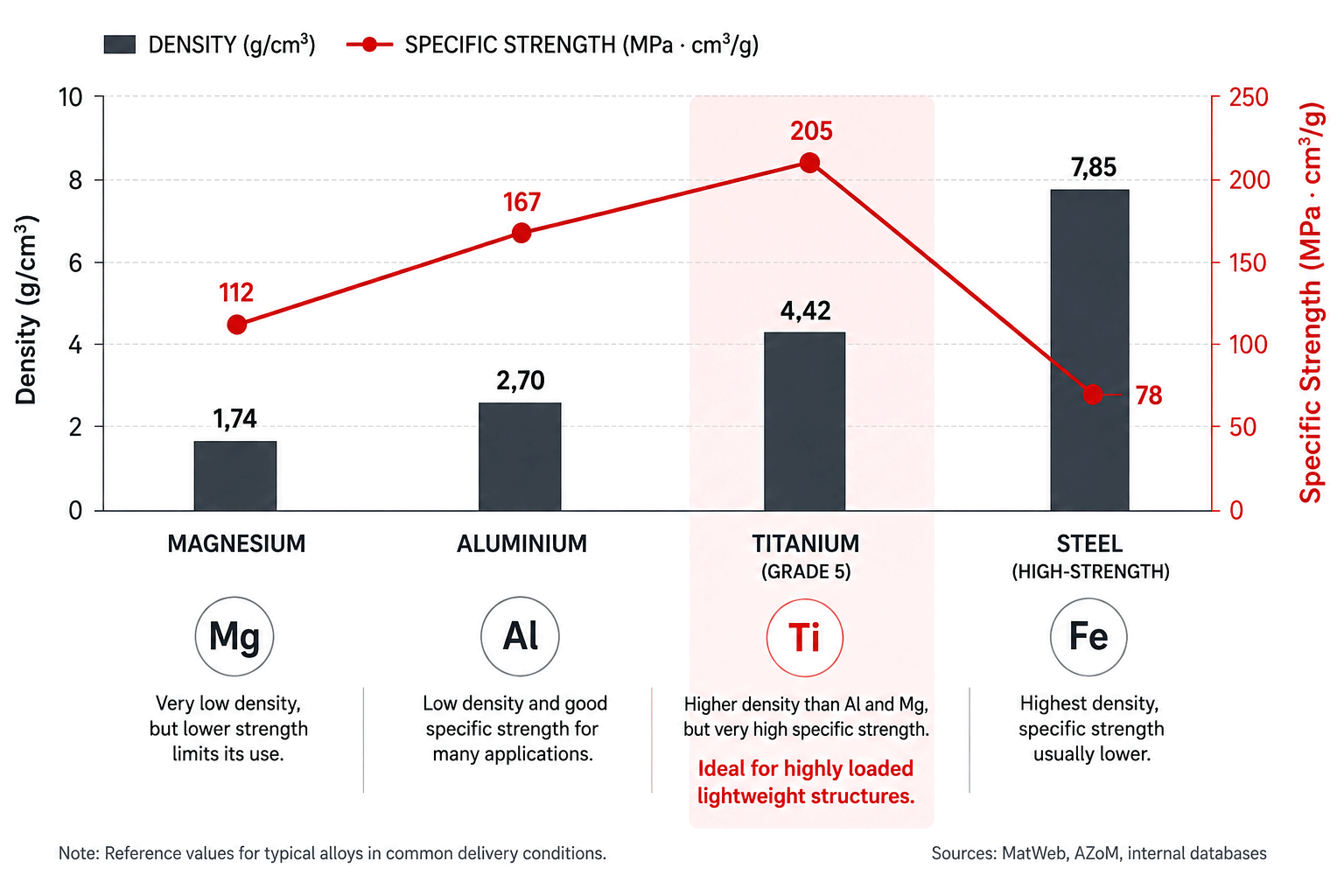
The following graphic illustrates why density alone is not sufficient when selecting an engineering material. It is the relationship between strength and weight – known as specific strength – that provides a more meaningful basis for evaluating materials used in weight-optimized structures.
Titanium Grade 5 combines comparatively low density with high mechanical strength. This combination can provide significant advantages for highly loaded lightweight structures, particularly when factors such as corrosion resistance and the specific operating conditions must also be considered.
Which Titanium Material Is Suitable for Which Requirements?
Selecting a suitable titanium material depends on far more than individual properties such as density or tensile strength. The decisive factor is the combination of mechanical loading, corrosion resistance, operating temperature, component geometry and manufacturing process.
For applications where high corrosion resistance and good processability are particularly important, commercially pure titanium Grades 1 to 4 may be suitable. In general, strength and hardness increase with the grade, while formability decreases.
Grade 5 (Ti-6Al-4V) is one of the most widely used titanium alloys and combines high strength with comparatively low weight. It is therefore used, among other applications, for mechanically highly loaded components and lightweight structures.
Grade 7 is characterized by particularly high corrosion resistance, while Grade 9 (Ti-3Al-2.5V) offers an attractive combination of strength, weight and processability.
Which titanium alloy is technically and economically suitable must ultimately be assessed on the basis of the specific component requirements and the required material specification.
Frequently Asked Questions about Titanium Standards and Technical Data
Which standards are used for titanium materials?
Titanium materials are specified according to various national and international standards. Depending on the application, product form and industry, specifications such as ASTM, AMS, DIN, EN or ISO may apply. The relevant standard defines requirements for aspects such as chemical composition, mechanical properties and delivery condition.
Are different titanium material designations directly comparable?
Not necessarily. Similar or corresponding material designations do not automatically mean that the materials are completely equivalent. Requirements may differ depending on the standard, product form and delivery condition. For technical applications, the applicable specification should therefore always be checked.
Why do the technical properties of different titanium grades vary?
The properties of titanium are influenced by factors such as chemical composition, alloying elements, microstructure, heat treatment and delivery condition. Commercially pure titanium grades therefore have different properties from alloyed titanium materials such as Ti-6Al-4V.
Why is the specific strength of titanium important?
Specific strength describes the relationship between a material's strength and its density. Titanium alloys can combine comparatively low density with high mechanical strength. This makes them particularly interesting for applications in which both high load-bearing capacity and low weight are important.
Which titanium grade is suitable for my application?
The appropriate titanium grade depends on the specific requirements of the component. Factors such as mechanical loading, corrosion resistance, operating temperature, component geometry, manufacturing process and the required material specification should all be taken into account when selecting the material.
Do you need Support selecting a Titanium Material?
Selecting the appropriate titanium grade and material specification depends on the technical requirements of the component, operating conditions and the intended manufacturing process.
Form & Technik supports you in selecting suitable titanium materials and implementing technically demanding components. Together, we consider material, geometry, manufacturing process and application to develop a technically and economically suitable solution.
From commercially pure titanium and high-strength titanium alloys to individual components and custom solutions, you benefit from our many years of experience with titanium and a wide range of manufacturing processes.