

Titanium Microstructure
The microstructure of a titanium material has a significant influence on its mechanical and technological properties. It is determined by factors including the chemical composition, titanium alloy, forming processes, heat treatment and cooling conditions.
Depending on the material and processing route, different microstructures can develop. These can influence properties such as strength, ductility, fatigue behaviour and temperature resistance. Understanding the microstructure is therefore an important aspect when evaluating and selecting titanium materials for technically demanding applications.
What is meant by the Microstructure of Titanium?
The microstructure – also referred to as the metallurgical structure of a material – describes the internal structure of a metallic material that can be made visible and examined at an appropriate level of magnification.
In titanium, the following characteristics are particularly relevant:
- Grain size: Size of the individual crystalline grains within the material.
- Grain shape: Geometrical form of the individual grains.
- Grain distribution: Arrangement and size distribution of the grains within the microstructure.
- Phase distribution: Proportion and spatial distribution of the phases present.
- Crystallographic orientation: Orientation of the individual crystalline grains within the material.
These characteristics do not develop randomly. They are influenced both by the composition of the titanium material and by its manufacturing and processing history.
In titanium, the relationship between the alpha and beta phases is particularly important. Depending on alloy composition and temperature, titanium materials can exhibit alpha, beta or combined alpha-beta microstructures.
Alpha, Alpha-Beta and Beta Microstructures in Titanium
Depending on temperature and alloy composition, titanium can exist in different crystalline phases. For the technical classification of titanium materials, the alpha phase (α) and beta phase (β) are particularly important.
At room temperature, commercially pure titanium predominantly exists in the alpha phase, which has a hexagonal crystal structure. Above a certain temperature, the structure transforms into the beta phase, which has a body-centred cubic crystal structure. The temperature at which this transformation occurs is known as the beta-transus temperature and depends on the respective titanium alloy.
By adding specific alloying elements, the alpha or beta phase can be stabilised, allowing the material properties to be influenced. This results in different groups of titanium materials:
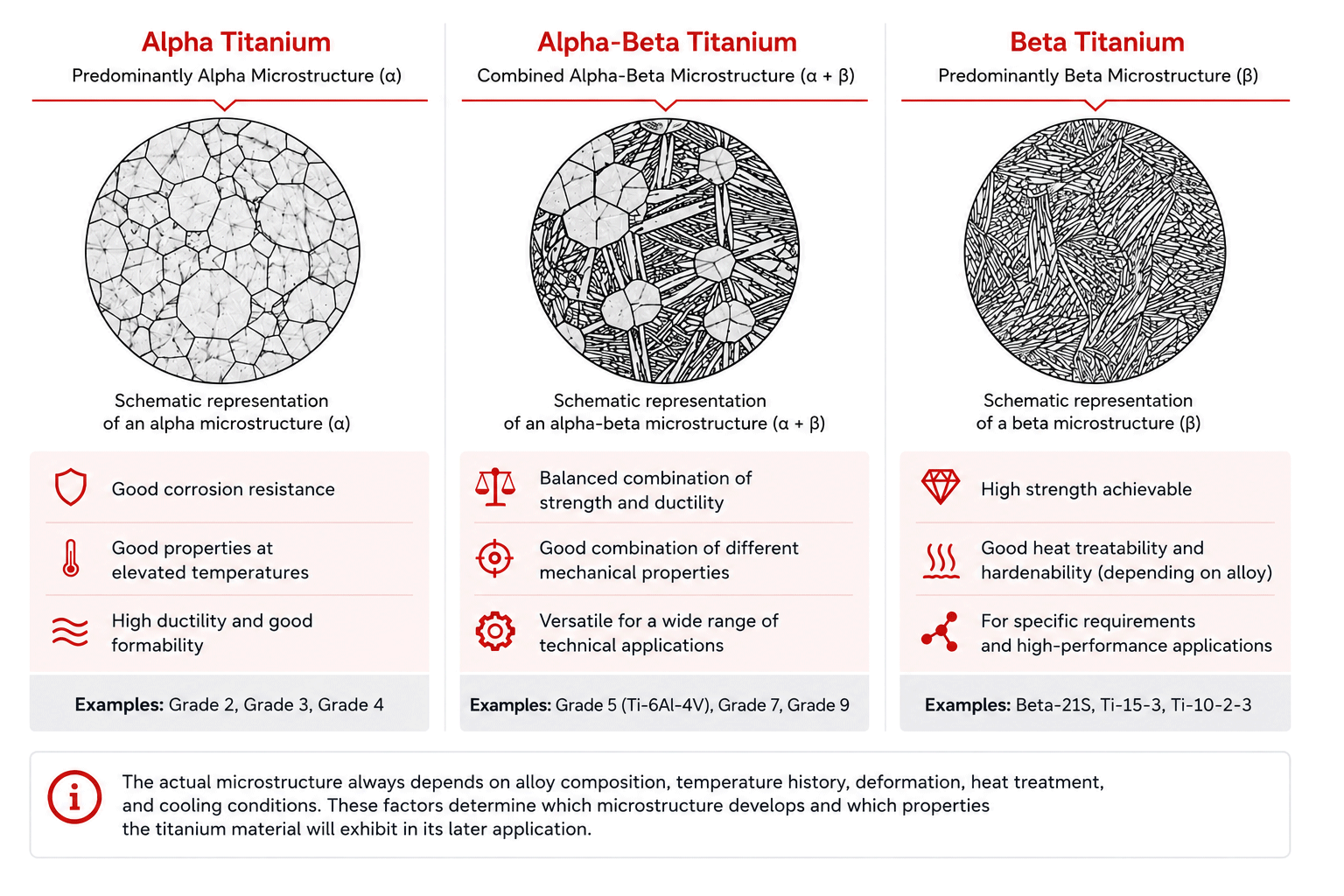
- Alpha titanium alloys: Predominantly alpha microstructure; good corrosion resistance and, depending on the alloy, good properties at elevated temperatures.
- Alpha-beta titanium alloys: Combination of alpha and beta phases, providing a balanced range of mechanical properties. A well-known example is Titanium Grade 5 (Ti-6Al-4V).
- Beta titanium alloys: High proportion or stabilisation of the beta phase; depending on the alloy, high strength levels can be achieved and properties can be modified through heat treatment.
The resulting microstructure therefore depends not only on the chemical composition. Temperature history, forming, heat treatment and cooling rate also influence the final microstructure of a titanium material.
Further information on how different alloy and microstructure types affect strength, density, corrosion resistance and other material characteristics can be found under Properties of Titanium.
Which Factors influence the Microstructure of Titanium?
The microstructure of a titanium material is determined by the interaction of alloy composition, temperature and processing. Even changes in individual process parameters can affect grain size, phase fractions and the resulting microstructure.
The most important influencing factors include:
- Alloy composition: Alloying elements can stabilise the alpha or beta phase and therefore specifically influence the resulting microstructure.
- Temperature: Phase transformations can occur during heating. Of particular importance is whether and to what extent the respective beta-transus temperature is exceeded.
- Heat treatment: Defined temperatures and holding times can be used to influence the microstructure and therefore specific material properties.
- Cooling rate: Slow or rapid cooling following heat treatment can result in different phase fractions and microstructural morphologies.
- Forming: Forging, rolling and other forming processes alter the existing grain structure and can influence the mechanical properties of the material.
- Manufacturing process: Casting, additive manufacturing and other production processes can produce characteristic initial microstructures as a result of their different thermal histories.
The microstructure can therefore be regarded as the result of the entire material and processing history of a titanium component. Two components made from comparable titanium alloys may consequently exhibit different microstructures and properties depending on their manufacturing route and heat treatment.
How does Microstructure influence the properties of Titanium?
The microstructure of a titanium material has a significant influence on how the material behaves under mechanical and thermal loads. Grain size, phase fractions and their distribution can therefore directly affect the properties of a titanium component.
Properties that can be influenced by the microstructure include:
- Strength: Microstructure and grain size can significantly influence the achievable strength of a titanium material.
- Ductility and formability: The distribution of alpha and beta phases influences the material’s ability to undergo plastic deformation.
- Fatigue behaviour: In dynamically loaded components, the microstructure can influence the initiation and propagation of fatigue cracks.
- Fracture toughness: Microstructure and phase distribution influence the material’s resistance to the propagation of existing cracks.
- Temperature behaviour: The stability of the phases present is particularly important for applications at elevated temperatures.
- Machinability and processing: Different microstructures can also affect machining, forming and other manufacturing operations.
A titanium material should therefore not be assessed solely on the basis of its chemical composition or Grade designation. Material, microstructure, manufacturing process and subsequent operating conditions must be considered together when designing a component for a technically demanding application.
An overview of density, strength, corrosion resistance and other technical characteristics can be found under Properties of Titanium.
How is the Microstructure of Titanium examined?
To evaluate the microstructure of a titanium material, a representative sample is typically taken and prepared using metallographic techniques. The sample is ground, polished and subsequently etched using suitable methods. This makes grain boundaries, different phases and other microstructural features visible.
The prepared surface can then be examined using methods such as optical microscopy or scanning electron microscopy (SEM). Depending on the examination method, characteristics including grain size, grain shape, phase distribution and characteristic microstructural features can be evaluated. This can provide information about the condition of the material as well as previous heat-treatment and manufacturing processes.
Microstructural analysis is therefore an important tool in materials engineering. It helps to understand the relationship between chemical composition, processing, microstructure and the resulting material properties of a titanium material.
Titanium Microstructure – Alpha, Alpha-Beta and Beta Compared
Depending on alloy composition and processing, titanium can develop different microstructures.
The three main types and their typical characteristics at a glance:
From Microstructure to the finished Titanium Component
The microstructure of a titanium material is not only relevant for materials engineering and evaluation, but also has practical significance for the design and manufacture of a component. Titanium Grade, microstructural condition, manufacturing process and subsequent operating conditions therefore need to be considered together.
Depending on the application, different requirements may take priority – for example high strength combined with low weight, corrosion resistance, temperature resistance or good processability. The appropriate titanium material should therefore always be selected with regard to component geometry, mechanical loads and the intended manufacturing process.
Form & Technik has many years of experience with titanium and a range of manufacturing processes for technically demanding titanium components. Depending on the component and its requirements, these include titanium investment castings, 3D Printing, titanium graphite castings, titanium forgings, titanium tubes and custom-made titanium components.
Frequently Asked Questions about Titanium Microstructure
What is meant by the microstructure of titanium?
The microstructure describes the internal structure of a titanium material. It includes characteristics such as grain size, grain shape, grain distribution, phase distribution and crystallographic orientation. It is significantly influenced by the alloy composition as well as by the manufacturing and processing history of the material.
Which types of microstructure occur in titanium?
Titanium is generally classified into alpha, alpha-beta and beta microstructures. The resulting microstructure depends on the respective titanium alloy as well as factors such as temperature, heat treatment, forming and cooling conditions.
Why is microstructure important for the properties of titanium?
The microstructure can significantly influence properties such as strength, ductility, fatigue behaviour, fracture toughness and temperature behaviour. In addition to chemical composition, the microstructural condition is therefore important when evaluating a titanium material.
Can the microstructure of titanium be deliberately modified?
Yes. Heat treatment, forming and controlled cooling conditions can be used to influence the development of the microstructure. The appropriate treatment depends on the respective titanium alloy and the desired material properties.
How is the microstructure of a titanium material examined?
For microstructural analysis, material samples are prepared using metallographic techniques and subsequently examined using methods such as optical microscopy or scanning electron microscopy (SEM). This allows characteristic microstructural features to be made visible and evaluated.
Selecting the Right Titanium Material for your Application
The properties of a titanium component are not determined by the Titanium Grade alone. Microstructure, manufacturing process, heat treatment and subsequent operating conditions also play an important role when selecting an appropriate material and component solution.
Form & Technik supports you in selecting suitable titanium materials and manufacturing processes for technically demanding applications – taking into account component geometry, mechanical requirements and operating conditions.