
Titanium 3D Printing
Additive Manufacturing of Titanium Components
Additive manufacturing enables the production of complex titanium components that would require considerable effort using conventional manufacturing processes or, in some cases, could not be produced at all. Form & Technik provides 3D-printed titanium components for demanding technical applications – from prototypes and individual parts to small series.
Especially for complex geometries, weight-optimized designs and components with integrated functions, metal 3D printing opens up new possibilities in design and manufacturing.
Advantages of 3D-Printed Titanium Components
Additive manufacturing combines the exceptional material properties of titanium with a high degree of geometric design freedom. Components can be specifically designed for their function and load requirements without being unnecessarily restricted by the limitations of conventional manufacturing processes.
Advantages at a glance:
- high design freedom for complex geometries
- weight-optimized and intricate designs
- integration of multiple functions into a single component
- production of individual parts, prototypes and small series
- tool-free manufacturing based on digital 3D data
- material-efficient production
- realization of technically demanding titanium components
Titanium 3D Printing for Demanding Applications
3D-printed titanium components are particularly suitable for applications where low weight, high strength, corrosion resistance and complex component geometries need to be combined.
Potential applications range from technically demanding prototypes and functional components to customized parts and small series for various industries.
Additive manufacturing enables designs that are specifically tailored to the respective application. Geometries that would require considerable manufacturing effort and material consumption with conventional machining processes can also be produced efficiently using this technology.
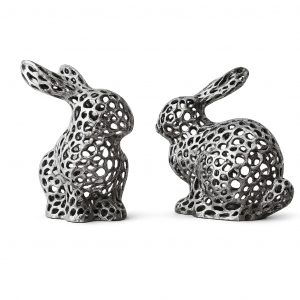
The 3D-printed structures shown here clearly demonstrate the high degree of design freedom offered by additive manufacturing. Even complex, detailed and free-form geometries can be produced directly from digital 3D data – without conventional tooling and with a high degree of design flexibility.
What is demonstrated here using an unusual geometry can be transferred directly to technical applications: 3D printing enables component shapes, undercuts and complex structures that would require considerable effort using conventional manufacturing processes or, in some cases, could not be produced at all.
Some of the images have been digitally or AI-assisted optimized and may differ in detail from the actual appearance of the components.
Additive Manufacturing of Titanium – Processes and Possibilities
In additive manufacturing, components are built layer by layer based on digital 3D data. Unlike conventional subtractive manufacturing processes, the desired geometry is not machined from a solid piece of material but is created selectively, layer by layer.
For titanium in particular, this manufacturing principle offers significant possibilities. Complex geometries, internal structures, undercuts and weight-optimized designs can already be taken into account during component development. This allows the design to be more closely tailored to the component’s intended function.
From 3D Data to the Finished Component
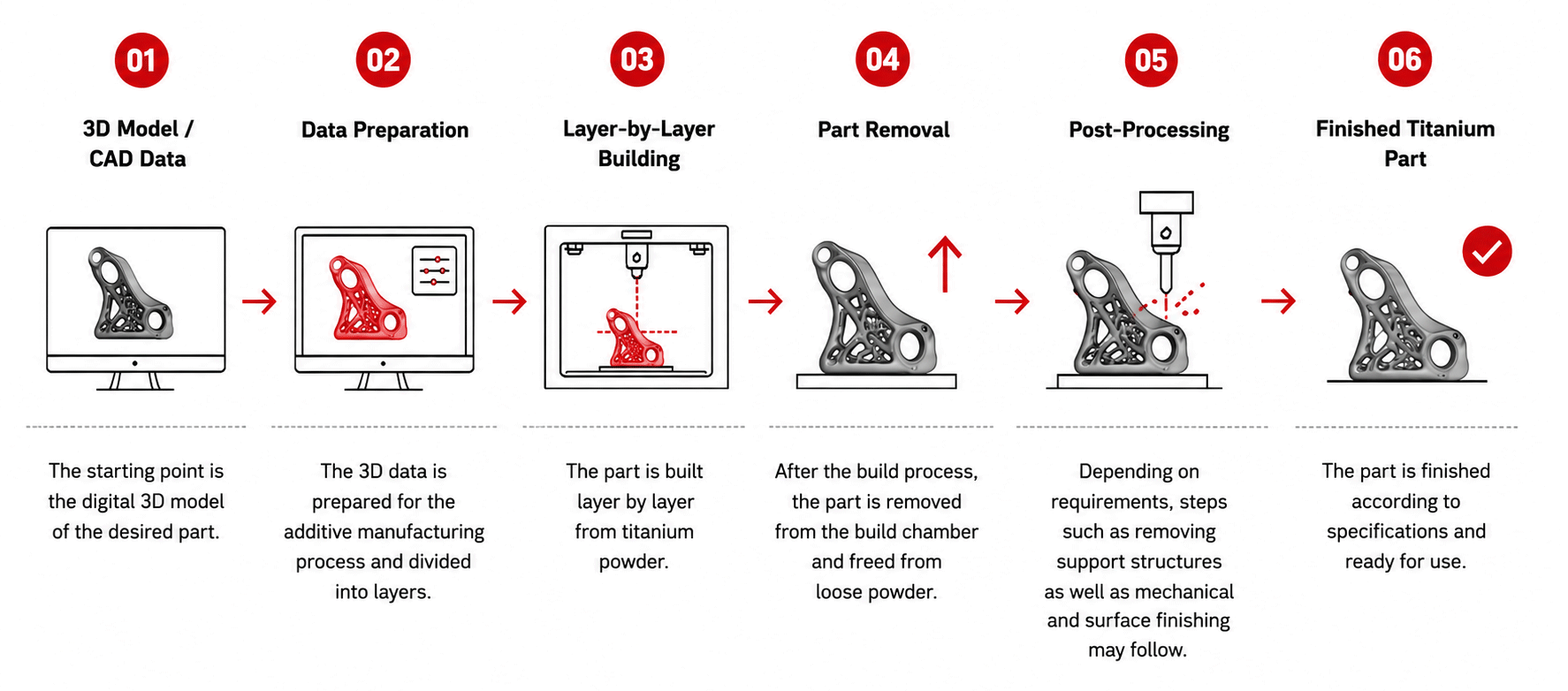
The process starts with a digital 3D model of the desired component. The data is prepared for the additive manufacturing process and the component is subsequently built layer by layer. Depending on the component geometry, material and intended application, additional processing steps may be required.
Form & Technik does not consider the actual 3D printing process in isolation. The decisive factor is ensuring that the manufacturing process, material and component design are suited to the respective technical requirements.
Component-Specific Manufacturing and Post-Processing
The production of a technical component is not necessarily complete once the additive build process has finished. Depending on the geometry, function and required component properties, additional manufacturing steps may be necessary.
These may include, for example, the removal of process-related support structures as well as mechanical or surface finishing. The appropriate or necessary processing steps depend on the specific requirements of the component.
The Right Manufacturing Process for Your Application
Not every titanium component is automatically suited to 3D printing. Production quantity, dimensions, geometry, material requirements and economic considerations determine which manufacturing process represents the most suitable solution for a particular application.
Thanks to the broad manufacturing portfolio of Form & Technik, additive manufacturing can also be considered in combination with conventional processes such as investment casting, graphite casting or forging. The objective is not to use a particular manufacturing process at any cost, but to identify a technically and economically suitable solution for each individual component.
Customized 3D-Printed Titanium Components for Your Application
Would you like to have a complex titanium component additively manufactured or determine whether 3D printing is suitable for your application?
Send us your 3D data, drawing or technical requirements. Form & Technik will support you in selecting a suitable manufacturing solution and implementing your individual component requirements. Talk to us about your project.